
Software Decision Intelligence
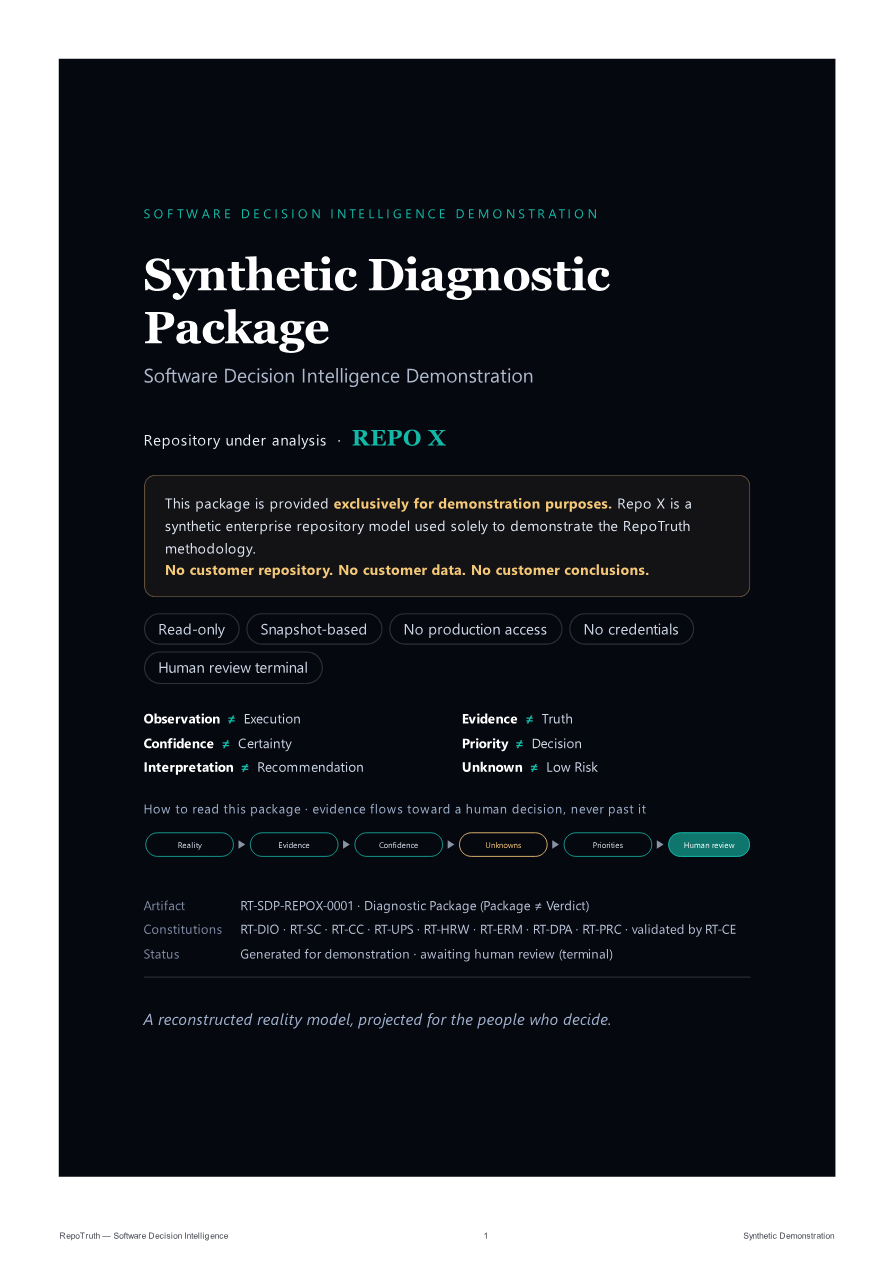
Synthetic Diagnostic Package
Demonstration generated from the constitutional evolution of Weisender V5. Prepared exclusively to demonstrate the RepoTruth Software Decision Intelligence model.
- Artifact
- RT-SDP-WSV5-0001 · Diagnostic Package (Package ≠ Verdict)
- Subject
- Weisender V5 — synthetic constitutional-evolution model
- Constitutions
- RT-DIO · RT-SC · RT-CC · RT-UPS · RT-HRW · RT-ERM · RT-DPA · RT-PRC · validated by RT-CE
- Basis
- Read-only, snapshot-based observation. No production access. No credentials.
- Status
- Generated for demonstration · awaiting human review (terminal)
What this dossier is — and is not
This package surfaces evidence, confidence, review priorities, and preserved unknowns. It contains no score, no grade, no verdict, and no recommendation. Every output is offered for human review, which remains the only place a decision is made.
Evidence Visualization Layer
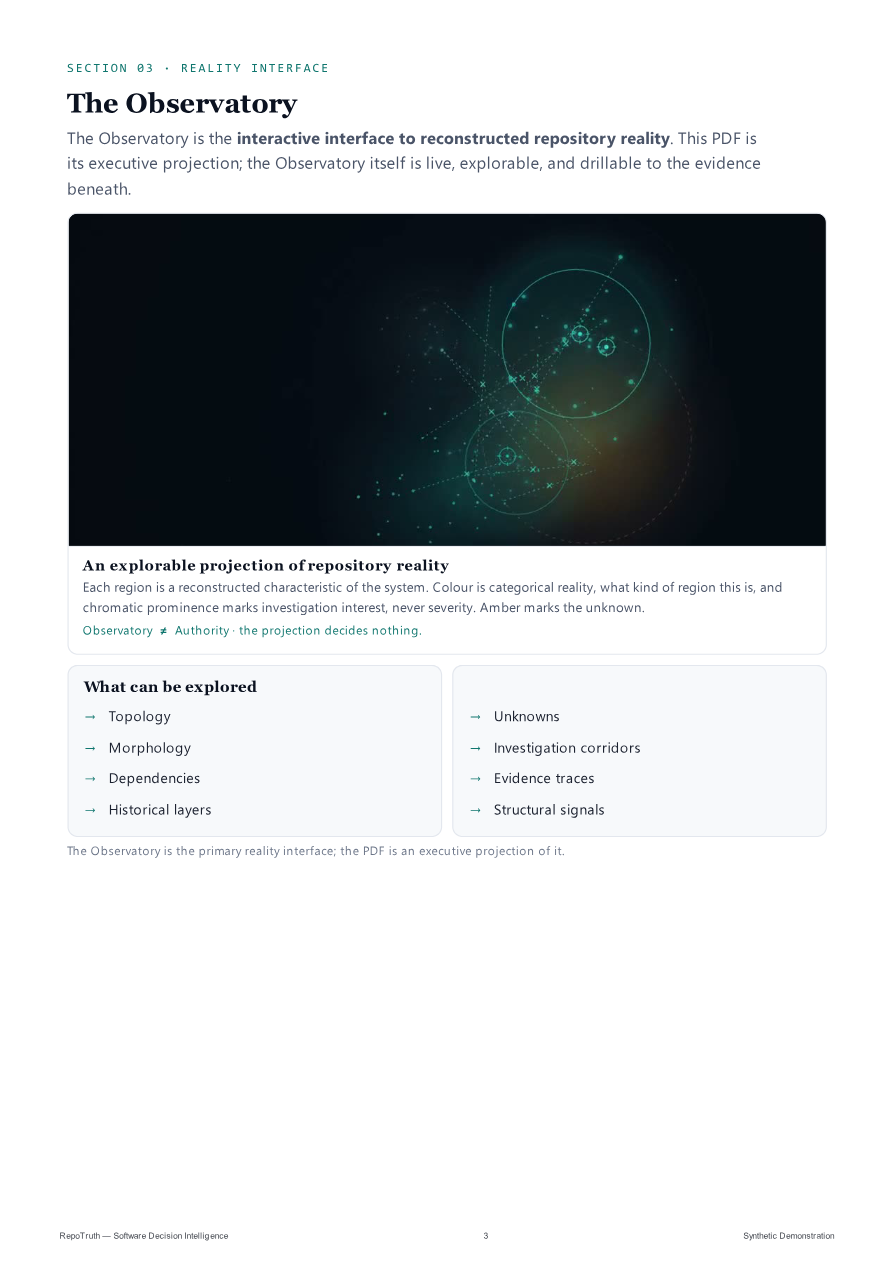
The Observatory — evidence in motion.
Every Diagnostic Package is also a living projection. The Observatory renders the evidence — where dependency concentrates, where knowledge thins, where the unknowns cluster — and decides nothing. It shows; your people interpret.
Observatory ≠ Authority. A read-only visualization of evidence; it assigns no grades and decides nothing. Synthetic demonstration.
Preview the dossier
See the full package — page by page.
Ten A4 pages, exactly as delivered. Browse the preview below, or download the complete PDF. This is a synthetic demonstration — no customer data.











SECTION 02
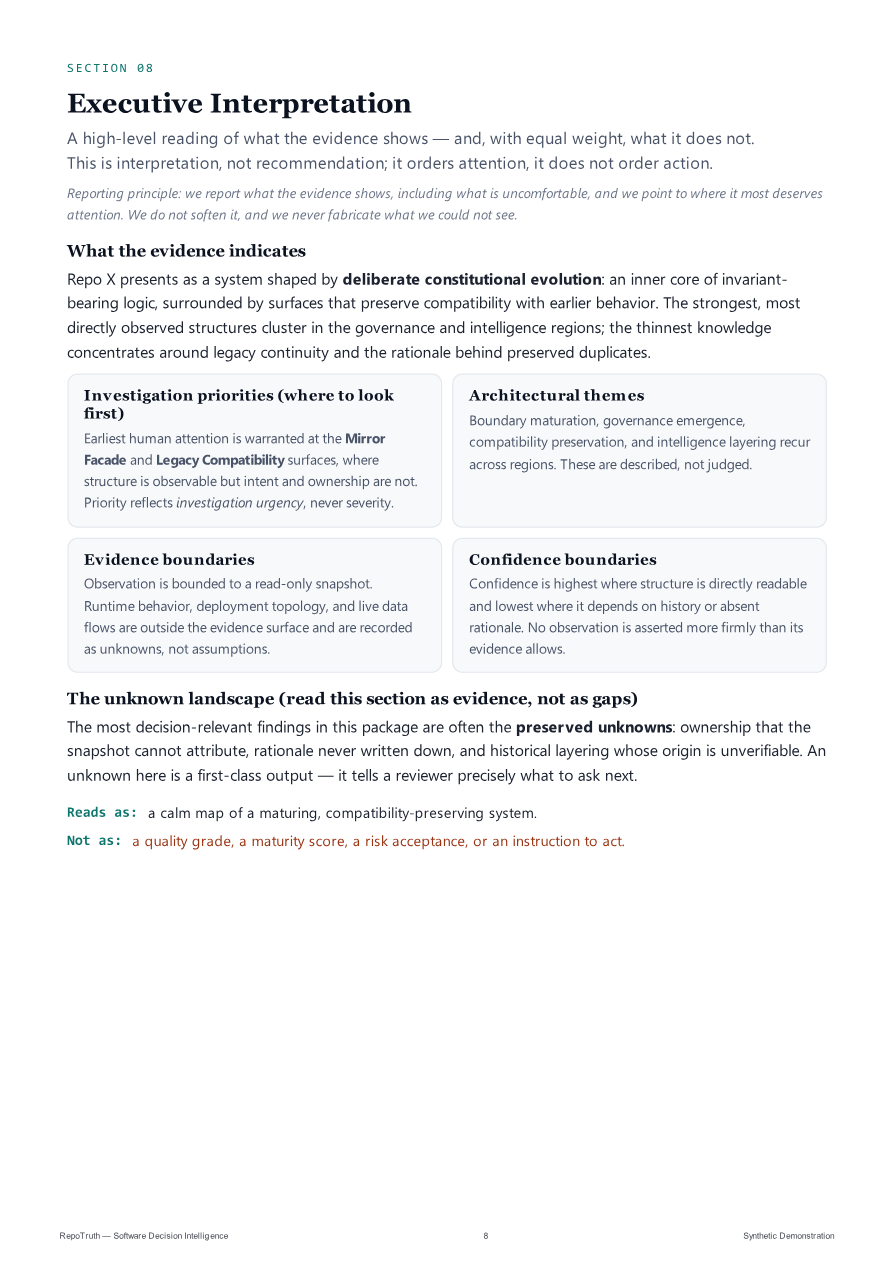
Executive Interpretation
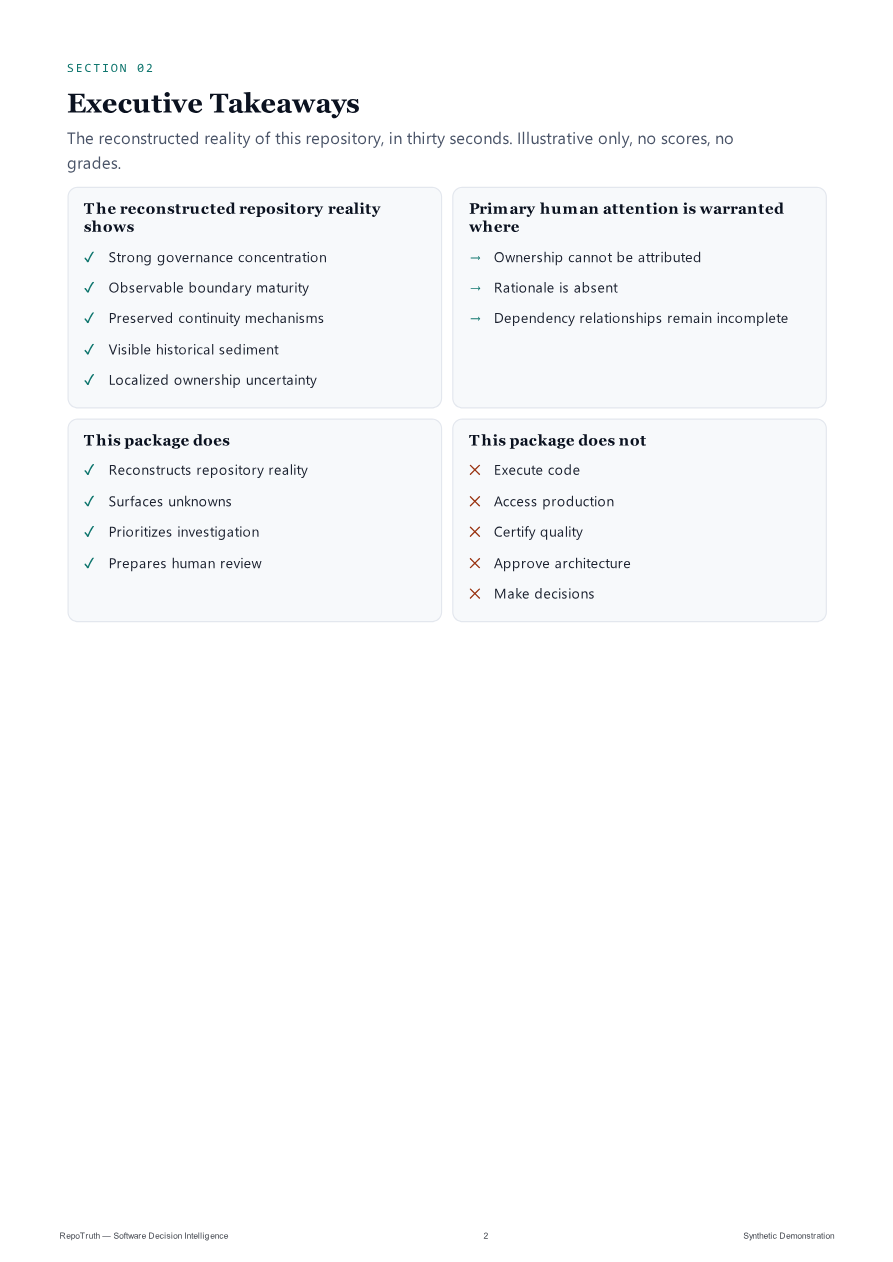
A high-level reading of what the evidence shows — and, with equal weight, what it does not. We say plainly what we saw, and point to where it most deserves your attention. This is interpretation, not recommendation; it orders attention, it does not order action.
What the evidence indicates
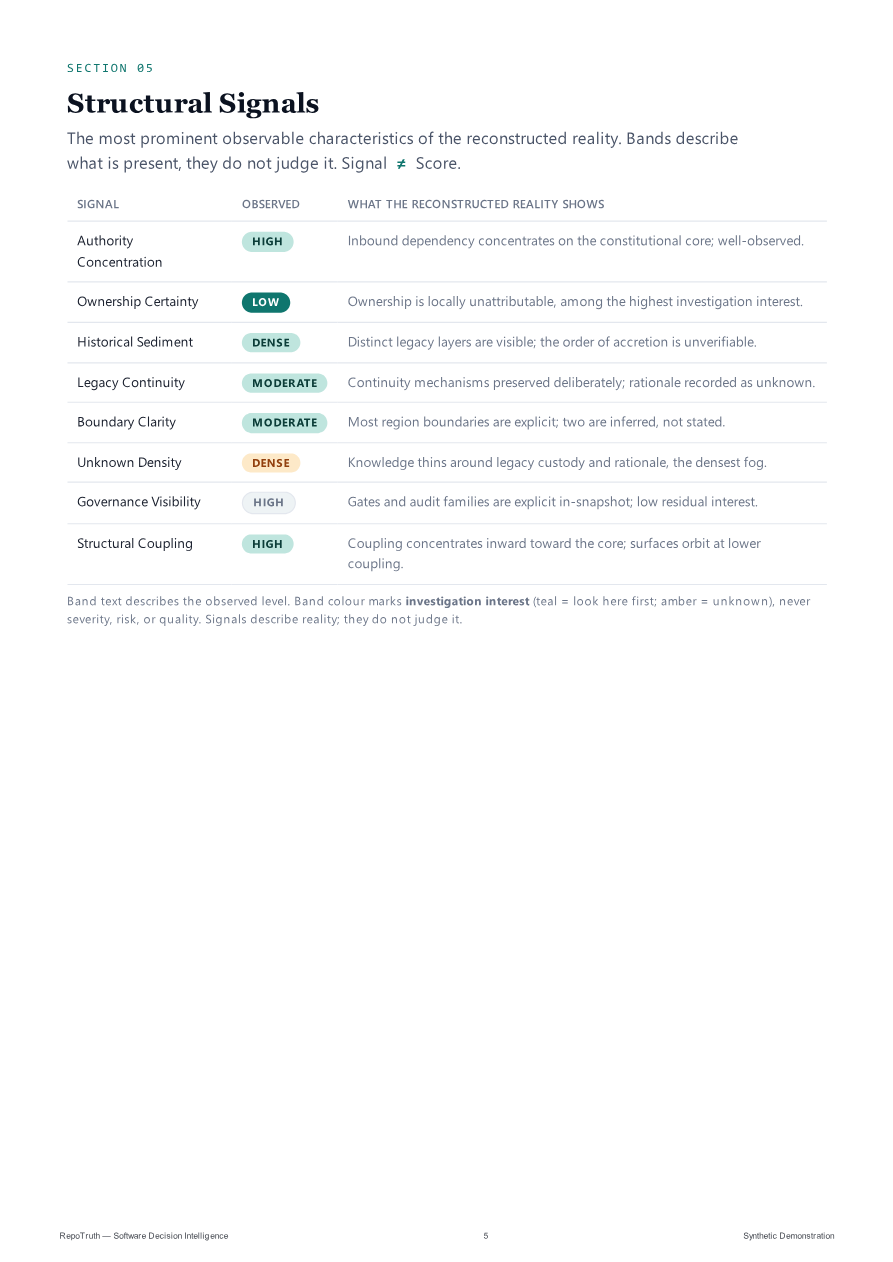
Weisender V5 presents as a system shaped by deliberate constitutional evolution: an inner core of invariant-bearing logic, surrounded by surfaces that preserve compatibility with earlier behavior. The strongest, most directly observed structures cluster in the governance and intelligence regions; the thinnest knowledge concentrates around legacy continuity and the rationale behind preserved duplicates.
Investigation priorities (where to look first)
Earliest human attention is warranted at the Mirror Facade and Legacy Compatibility surfaces, where structure is observable but intent and ownership are not. Priority reflects investigation urgency, never severity.
Architectural themes
Boundary maturation, governance emergence, compatibility preservation, and intelligence layering recur across regions. These are described, not judged.
Evidence boundaries
Observation is bounded to a read-only snapshot. Runtime behavior, deployment topology, and live data flows are outside the evidence surface and are recorded as unknowns, not assumptions.
Confidence boundaries
Confidence is highest where structure is directly readable and lowest where it depends on history or absent rationale. No observation is asserted more firmly than its evidence allows.
The unknown landscape (read this section as evidence, not as gaps)
The most decision-relevant findings in this package are often the preserved unknowns: ownership that the snapshot cannot attribute, rationale never written down, and historical layering whose origin is unverifiable. An unknown here is a first-class output — it tells a reviewer precisely what to ask next.
SECTION 03
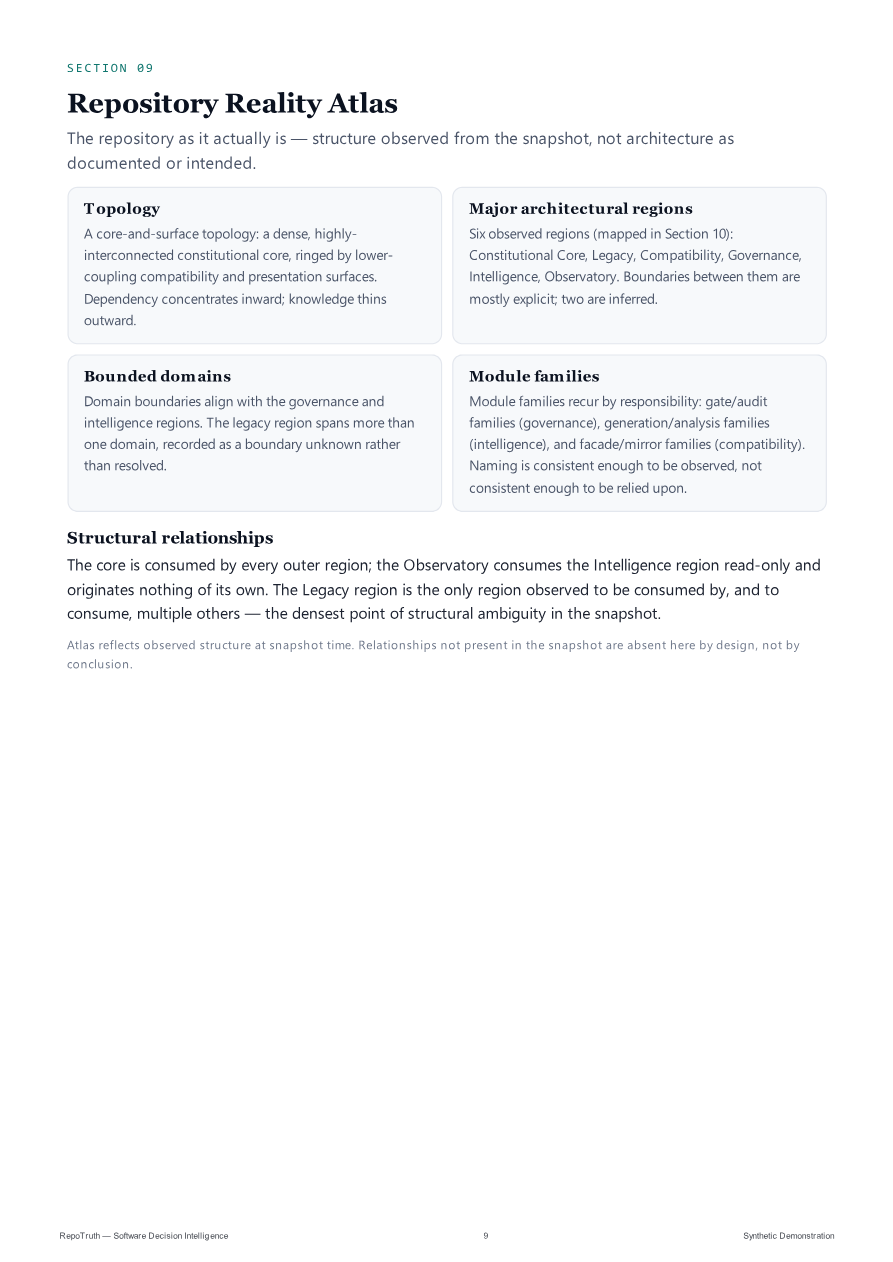
Repository Reality Atlas
The repository as it actually is — structure observed from the snapshot, not architecture as documented or intended.
Topology
A core-and-surface topology: a dense, highly-interconnected constitutional core, ringed by lower-coupling compatibility and presentation surfaces. Dependency concentrates inward; knowledge thins outward.
Major architectural regions
Six observed regions (mapped in Section 04): Constitutional Core, Legacy, Compatibility, Governance, Intelligence, Observatory. Boundaries between them are mostly explicit; two are inferred.
Bounded domains
Domain boundaries align with the governance and intelligence regions. The legacy region spans more than one domain, which is recorded as a boundary unknown rather than resolved.
Module families
Module families recur by responsibility: gate/audit families (governance), generation/analysis families (intelligence), and facade/mirror families (compatibility). Naming is consistent enough to be observed, not consistent enough to be relied upon.
Structural relationships
The core is consumed by every outer region; the Observatory consumes the Intelligence region read-only and originates nothing of its own. The Legacy region is the only region observed to be consumed by, and to consume, multiple others — the densest point of structural ambiguity in the snapshot.
Atlas reflects observed structure at snapshot time. Relationships not present in the snapshot are absent here by design, not by conclusion.
SECTION 04
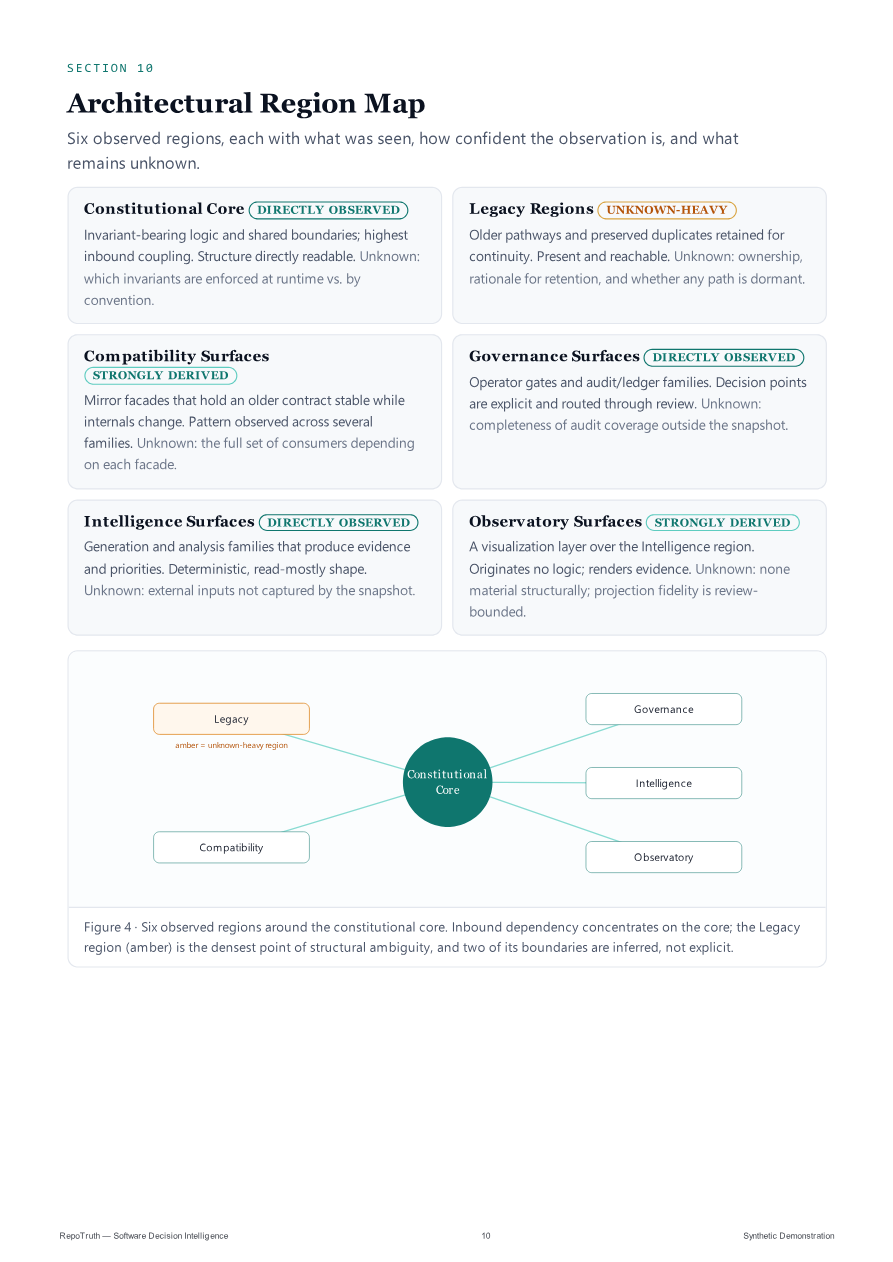
Architectural Region Map
Six observed regions, each with what was seen, how confident the observation is, and what remains unknown.
Constitutional Core Directly Observed
Invariant-bearing logic and shared boundaries; highest inbound coupling. Structure directly readable. Unknown: which invariants are enforced at runtime vs. by convention.
Legacy Regions Unknown-heavy
Older pathways and preserved duplicates retained for continuity. Present and reachable. Unknown: ownership, rationale for retention, and whether any path is dormant.
Compatibility Surfaces Strongly Derived
Mirror facades that hold an older contract stable while internals change. Pattern observed across several families. Unknown: the full set of consumers depending on each facade.
Governance Surfaces Directly Observed
Operator gates and audit/ledger families. Decision points are explicit and routed through review. Unknown: completeness of audit coverage outside the snapshot.
Intelligence Surfaces Directly Observed
Generation and analysis families that produce evidence and priorities. Deterministic, read-mostly shape. Unknown: external inputs not captured by the snapshot.
Observatory Surfaces Strongly Derived
A visualization layer over the Intelligence region. Originates no logic; renders evidence. Unknown: none material at the structural level; projection fidelity is review-bounded.
SECTION 05
Key Evidence Catalog
Representative evidence. Each item is an observation with a reference, a confidence level, and a note on how the surrounding unknowns affect it. Evidence ≠ Truth.
| Ref | Evidence summary | Confidence | Unknown impact |
|---|---|---|---|
| EV-001 | Constitutional core is the most depended-upon region; all surfaces reference it. | Directly Observed | Low — structure is explicit. |
| EV-014 | Mirror facades hold a stable external contract over changing internals. | Strongly Derived | Moderate — consumer set not fully enumerable from snapshot. |
| EV-022 | Preserved duplicate pathways exist in the legacy region. | Moderately Derived | High — rationale and ownership are unknown. |
| EV-031 | Operator gates route state-changing actions through explicit review. | Directly Observed | Low — gates are present in structure. |
| EV-047 | Observatory consumes intelligence outputs read-only; originates none. | Strongly Derived | Low — directionality observed. |
| EV-058 | Legacy region participates in more than one bounded domain. | Moderately Derived | High — boundary intent is unwritten. |
Catalog is representative, not exhaustive. References are traceable to the full evidence set in the generated package.
SECTION 06
Review Priority Register
Regions that warrant earlier human investigation. Order reflects investigation urgency — how much a reviewer's attention would change what is known. It never reflects severity, risk, or importance of the underlying code. Priority ≠ Decision.
Why urgency, not severity: RepoTruth orders where understanding is thinnest and most consequential to investigate. It does not claim any region is good, bad, risky, or safe.
SECTION 07 · FLAGSHIP
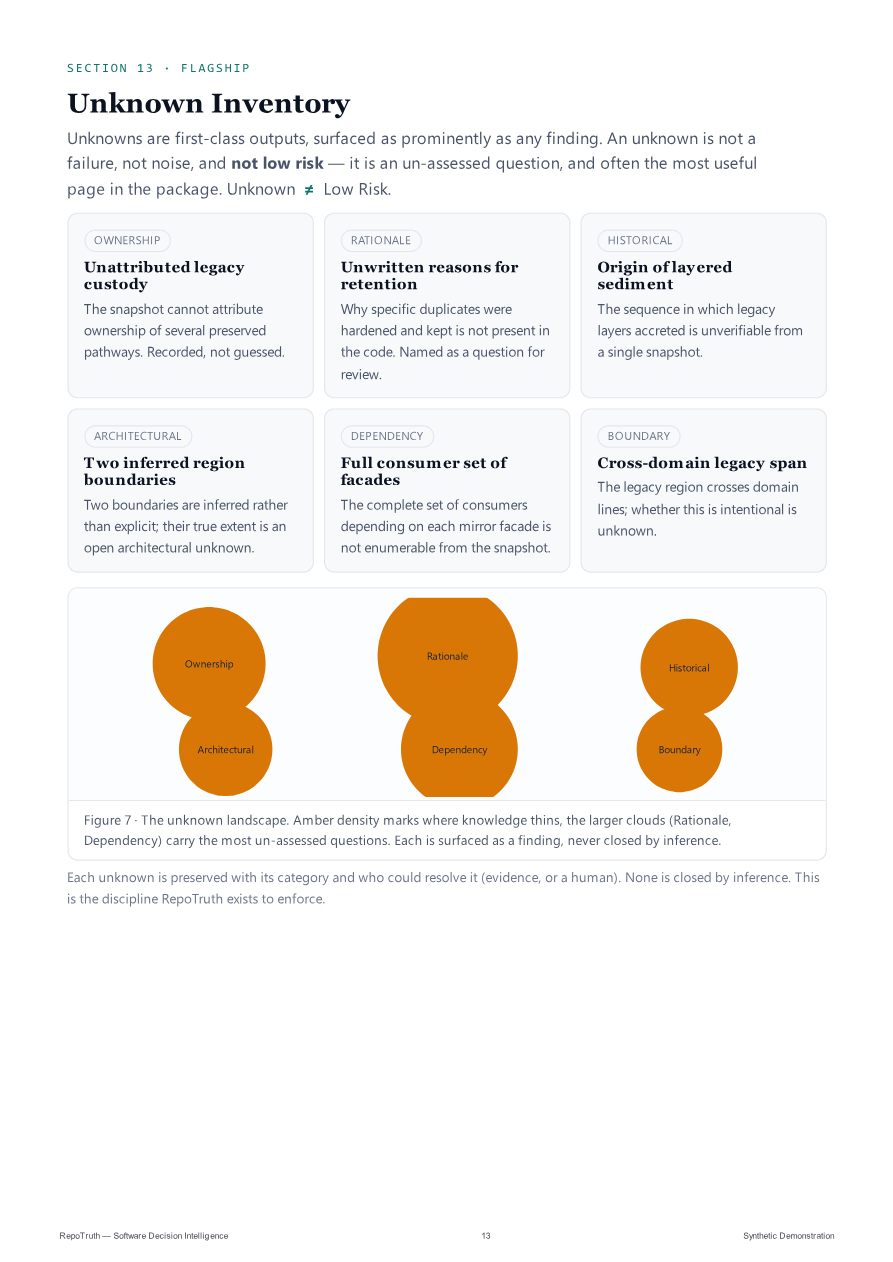
Unknown Inventory
Unknowns are first-class outputs, surfaced as prominently as any finding. An unknown is not a failure, not noise, and not low risk — it is an un-assessed question, and often the most useful page in the package. Unknown ≠ Low Risk.
Unattributed legacy custody
The snapshot cannot attribute ownership of several preserved pathways. Recorded, not guessed.
Unwritten reasons for retention
Why specific duplicates were hardened and kept is not present in the code. Named as a question for review.
Origin of layered sediment
The sequence in which legacy layers accreted is unverifiable from a single snapshot.
Two inferred region boundaries
Two boundaries are inferred rather than explicit; their true extent is an open architectural unknown.
Full consumer set of facades
The complete set of consumers depending on each mirror facade is not enumerable from the snapshot.
Cross-domain legacy span
The legacy region crosses domain lines; whether this is intentional is unknown.
Each unknown is preserved with its category and who could resolve it (evidence, or a human). None is closed by inference. This is the discipline RepoTruth exists to enforce.
SECTION 08
Confidence Matrix
How firmly each major observation is held, and why. Confidence is an epistemic level, not a quality score. There is no black-box confidence — every level is explainable. Confidence ≠ Certainty.
No observation in this package is asserted above the confidence its evidence permits. Where the matrix says “Unknown,” the package says so plainly.
SECTION 09
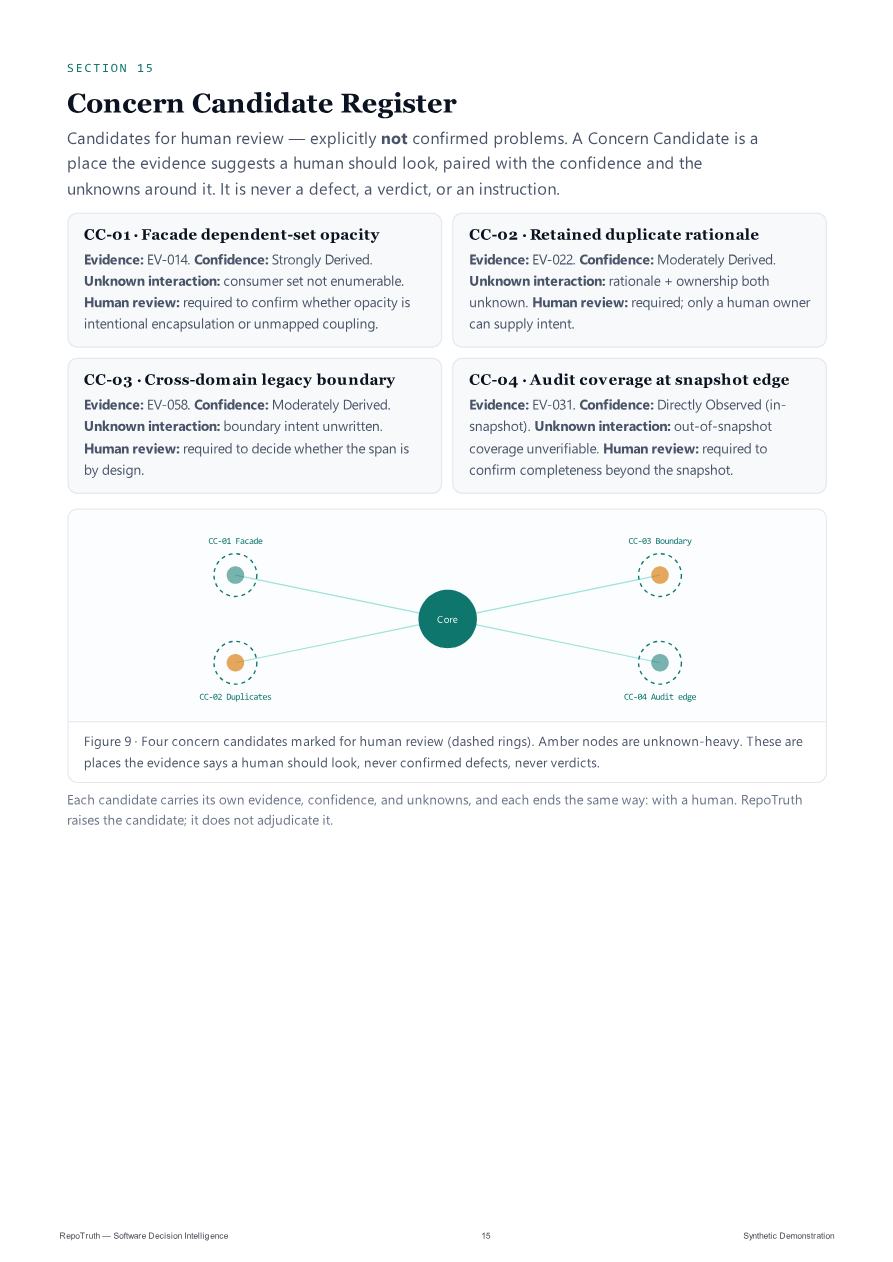
Concern Candidate Register
Candidates for human review — explicitly not confirmed problems. A Concern Candidate is a place the evidence suggests a human should look, paired with the confidence and the unknowns around it. It is never a defect, a verdict, or an instruction.
CC-01 · Facade dependent-set opacity
Evidence: EV-014. Confidence: Strongly Derived. Unknown interaction: consumer set not enumerable. Human review: required to confirm whether opacity is intentional encapsulation or unmapped coupling.
CC-02 · Retained duplicate rationale
Evidence: EV-022. Confidence: Moderately Derived. Unknown interaction: rationale + ownership both unknown. Human review: required; only a human owner can supply intent.
CC-03 · Cross-domain legacy boundary
Evidence: EV-058. Confidence: Moderately Derived. Unknown interaction: boundary intent unwritten. Human review: required to decide whether the span is by design.
CC-04 · Audit coverage at snapshot edge
Evidence: EV-031. Confidence: Directly Observed (in-snapshot). Unknown interaction: out-of-snapshot coverage unverifiable. Human review: required to confirm completeness beyond the snapshot.
Each candidate carries its own evidence, confidence, and unknowns, and each ends the same way: with a human. RepoTruth raises the candidate; it does not adjudicate it.
SECTION 10
Investigation Corridors
Suggested paths for human investigation — a way of looking, never a way of acting. Corridors are for human review only; they prescribe nothing.
Legacy Compatibility Corridor
Follow the preserved pathways from the legacy region outward to each compatibility surface that depends on them. Purpose: convert continuity unknowns into owned decisions.
Constitutional Continuity Corridor
Trace the invariant-bearing core to the surfaces that consume it. Purpose: see where the constitution is enforced vs. assumed.
Governance Evolution Corridor
Walk the gate and audit families across regions. Purpose: read how decision points emerged and where their coverage ends.
Mirror Facade Corridor
Enter each mirror facade and map its true dependents. Purpose: resolve the highest-priority dependency opacity first.
A corridor is a lens, not a lever. It tells your people where to walk and what to ask — your people decide what, if anything, to do.
SECTION 11
Constitutional Evolution Summary
The observable constitutional evolution of Weisender V5, described — not evaluated.
Boundary maturation
Region boundaries are observed to have become more explicit over the system's layers; two remain inferred. Described as a trajectory, not graded.
Governance emergence
Explicit gates and audit families are present where state changes. Their emergence is observable in structure; their sufficiency is a matter for human review.
Compatibility preservation
Mirror facades and continuity mechanisms recur, holding older contracts stable. A consistent pattern, neither endorsed nor faulted here.
Intelligence layering
A read-mostly intelligence region sits above the core, with an observatory layer above it that renders rather than originates.
No statement in this section asserts that any evolution is good, complete, correct, or finished. It records what is observable.
SECTION 12
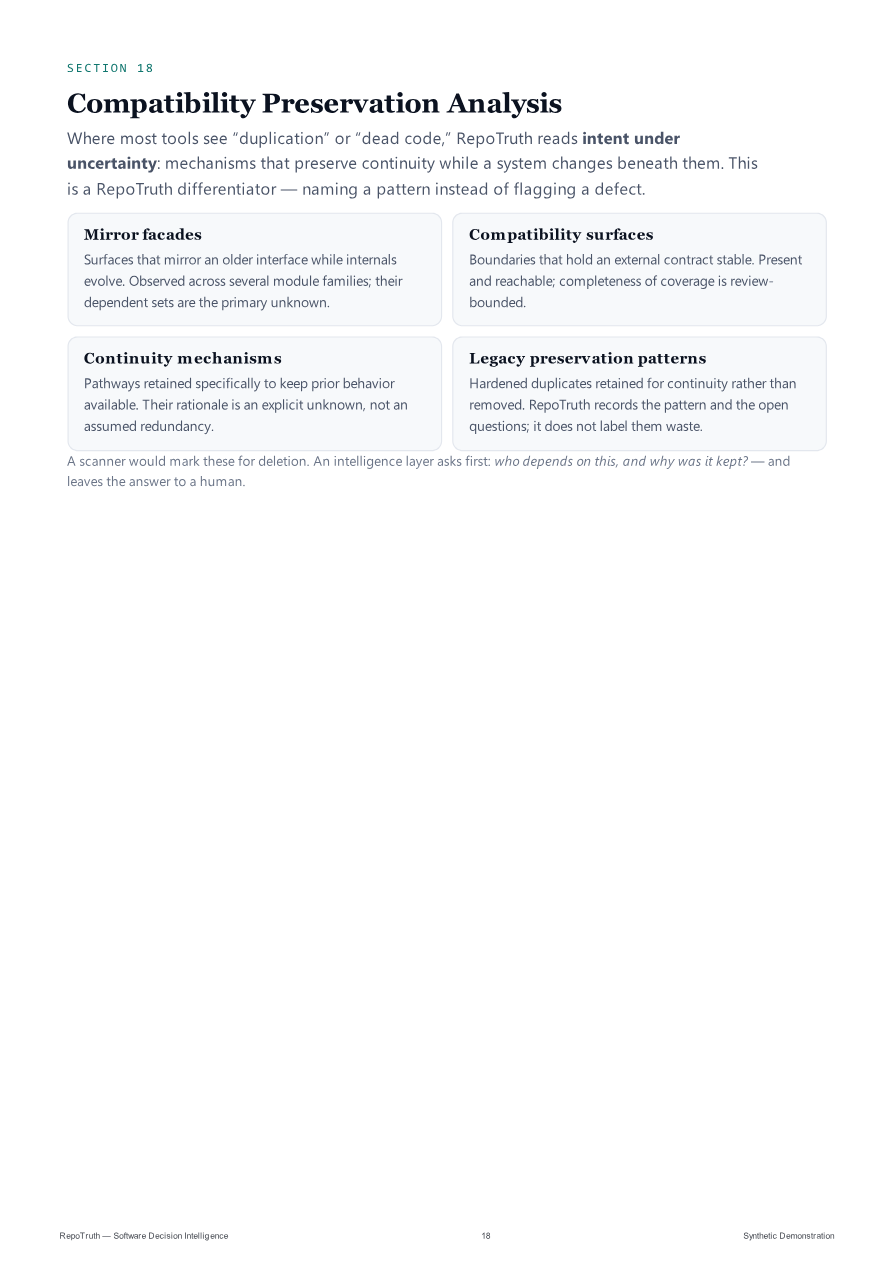
Compatibility Preservation Analysis
Where most tools see “duplication” or “dead code,” RepoTruth reads intent under uncertainty: mechanisms that preserve continuity while a system changes beneath them. This is a RepoTruth differentiator — naming a pattern instead of flagging a defect.
Mirror facades
Surfaces that mirror an older interface while internals evolve. Observed across several module families; their dependent sets are the primary unknown.
Compatibility surfaces
Boundaries that hold an external contract stable. Present and reachable; completeness of coverage is review-bounded.
Continuity mechanisms
Pathways retained specifically to keep prior behavior available. Their rationale is an explicit unknown, not an assumed redundancy.
Legacy preservation patterns
Hardened duplicates retained for continuity rather than removed. RepoTruth records the pattern and the open questions; it does not label them waste.
A scanner would mark these for deletion. An intelligence layer asks first: who depends on this, and why was it kept? — and leaves the answer to a human.
SECTION 13
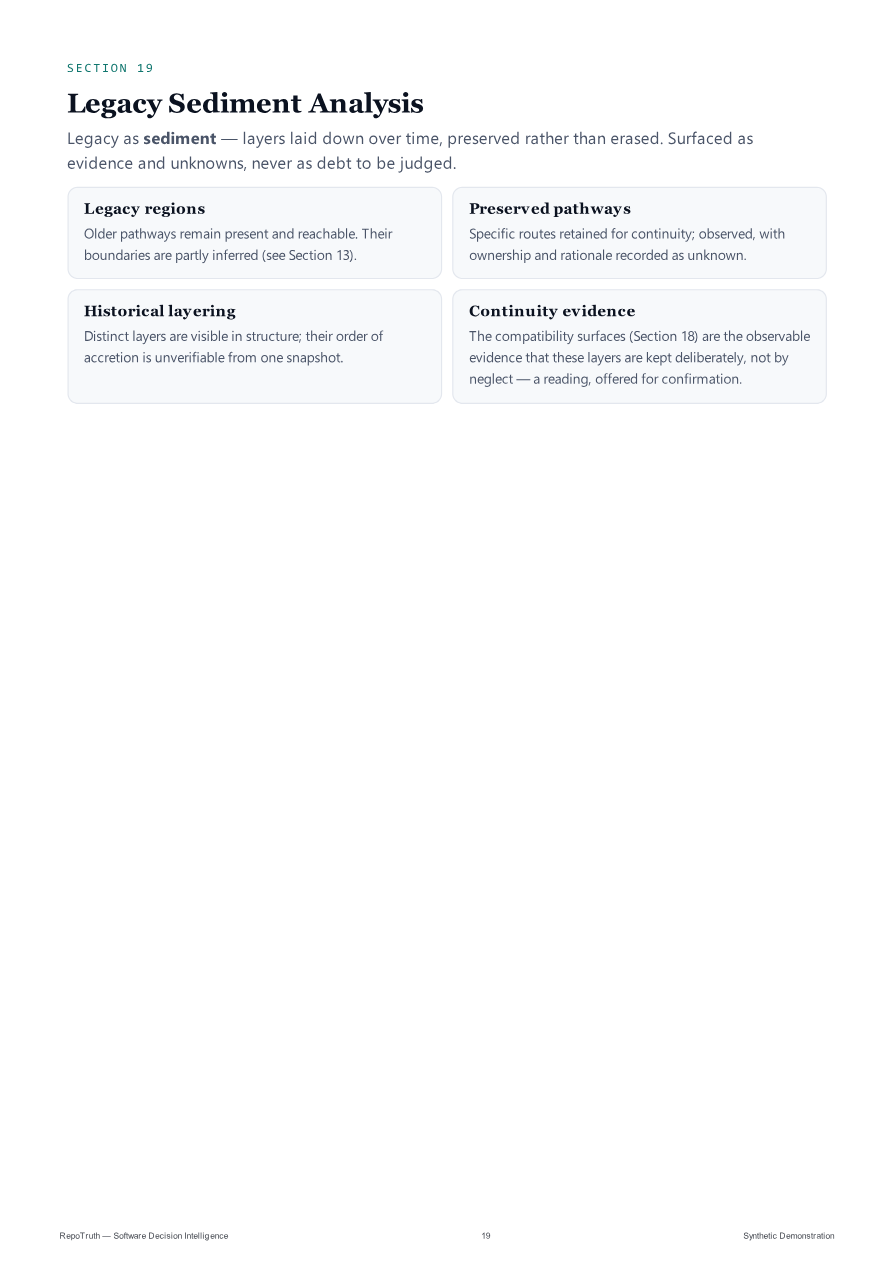
Legacy Sediment Analysis
Legacy as sediment — layers laid down over time, preserved rather than erased. Surfaced as evidence and unknowns, never as debt to be judged.
Legacy regions
Older pathways remain present and reachable. Their boundaries are partly inferred (see Section 07).
Preserved pathways
Specific routes retained for continuity; observed, with ownership and rationale recorded as unknown.
Historical layering
Distinct layers are visible in structure; their order of accretion is unverifiable from one snapshot.
Continuity evidence
The compatibility surfaces (Section 12) are the observable evidence that these layers are kept deliberately, not by neglect — a reading, offered for confirmation.
SECTION 14
Human Review Roadmap
What humans may wish to investigate next — investigation candidates only. This roadmap prescribes no actions and accepts no risk on anyone's behalf.
Each line is a question to investigate, paired with the candidate and priority it would resolve. None is a directive. What to do — and whether to do anything — is a human decision.
SECTION 15
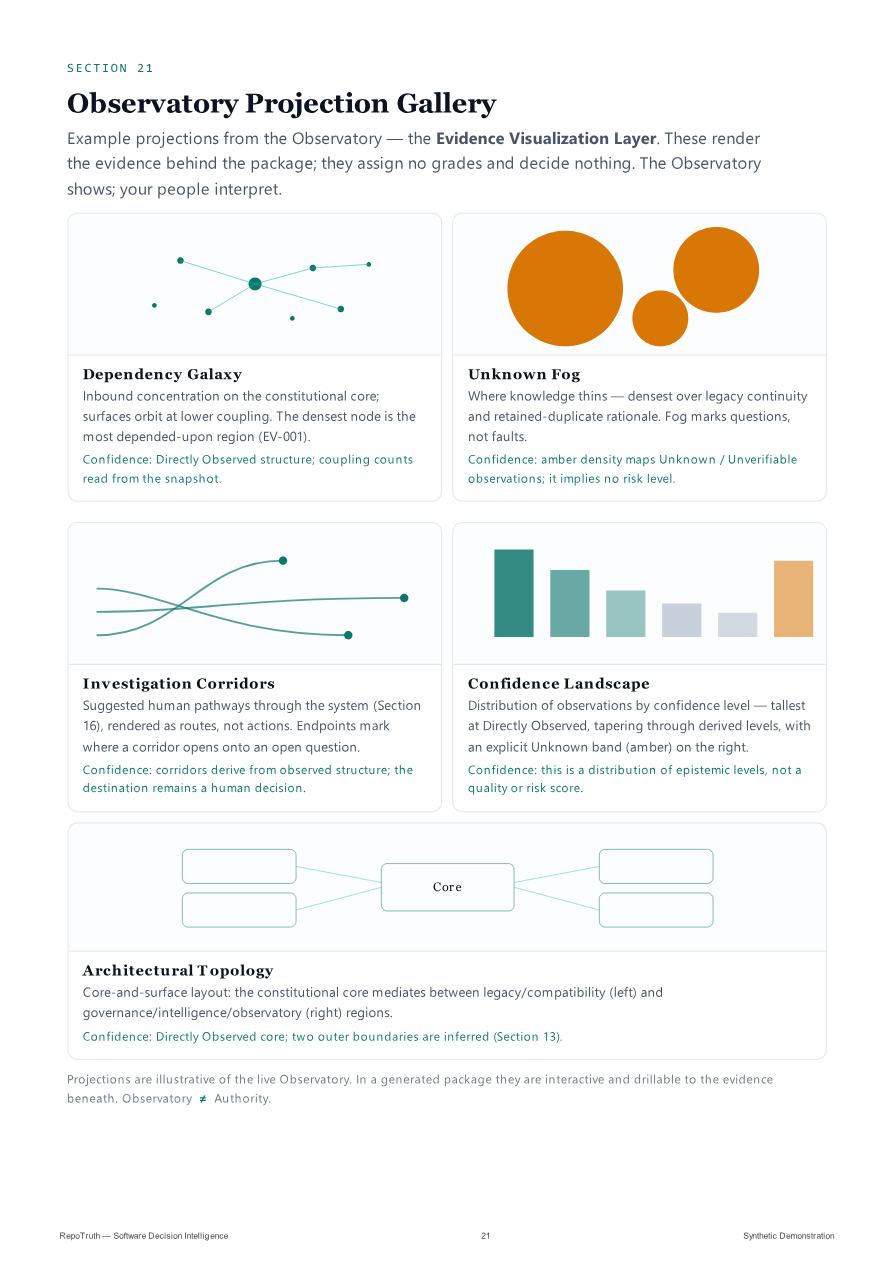
Observatory Projection Gallery
Example projections from the Observatory — the Evidence Visualization Layer. These render the evidence behind the package; they assign no grades and decide nothing. The Observatory shows; your people interpret.
Dependency Galaxy
Inbound concentration on the constitutional core; surfaces orbit at lower coupling.
Unknown Fog
Where knowledge thins — densest over legacy continuity and retained-duplicate rationale.
Investigation Corridors
Suggested human pathways through the system (Section 10), rendered as routes, not actions.
Confidence Landscape
Distribution of observations by confidence level — tallest at Directly Observed, with an explicit Unknown band (amber).
Architectural Topology
Core-and-surface layout: the constitutional core mediates between legacy/compatibility and governance/intelligence/observatory regions.
Projections are illustrative of the live Observatory. In a generated package they are interactive and drillable to the evidence beneath. Observatory ≠ Authority.
SECTION 16
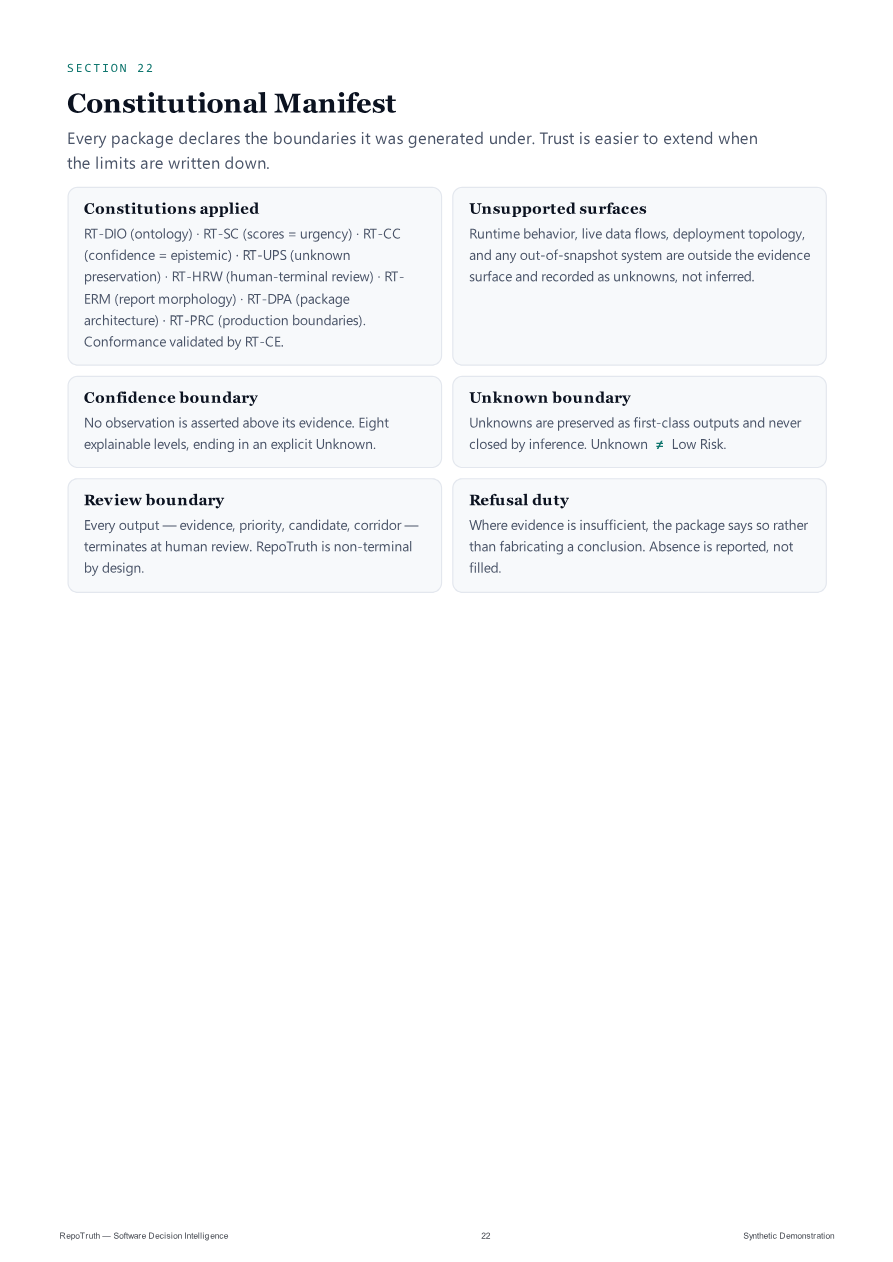
Constitutional Manifest
Every package declares the boundaries it was generated under. Trust is easier to extend when the limits are written down.
Constitutions applied
RT-DIO (ontology) · RT-SC (scores = urgency) · RT-CC (confidence = epistemic) · RT-UPS (unknown preservation) · RT-HRW (human-terminal review) · RT-ERM (report morphology) · RT-DPA (package architecture) · RT-PRC (production boundaries). Conformance validated by RT-CE.
Unsupported surfaces
Runtime behavior, live data flows, deployment topology, and any out-of-snapshot system are outside the evidence surface and recorded as unknowns, not inferred.
Confidence boundary
No observation is asserted above its evidence. Eight explainable levels, ending in an explicit Unknown.
Unknown boundary
Unknowns are preserved as first-class outputs and never closed by inference. Unknown ≠ Low Risk.
Review boundary
Every output — evidence, priority, candidate, corridor — terminates at human review. RepoTruth is non-terminal by design.
Refusal duty
Where evidence is insufficient, the package says so rather than fabricating a conclusion. Absence is reported, not filled.
SECTION 17
Final Boundary Statement
RepoTruth provides Software Decision Intelligence.
RepoTruth does not decide.
Human review remains mandatory.
This is a synthetic demonstration generated from the constitutional evolution of Weisender V5. No customer repository. No customer conclusions. No customer data. Evidence, confidence, priorities, and preserved unknowns are offered for human review — the only place a decision is made.